
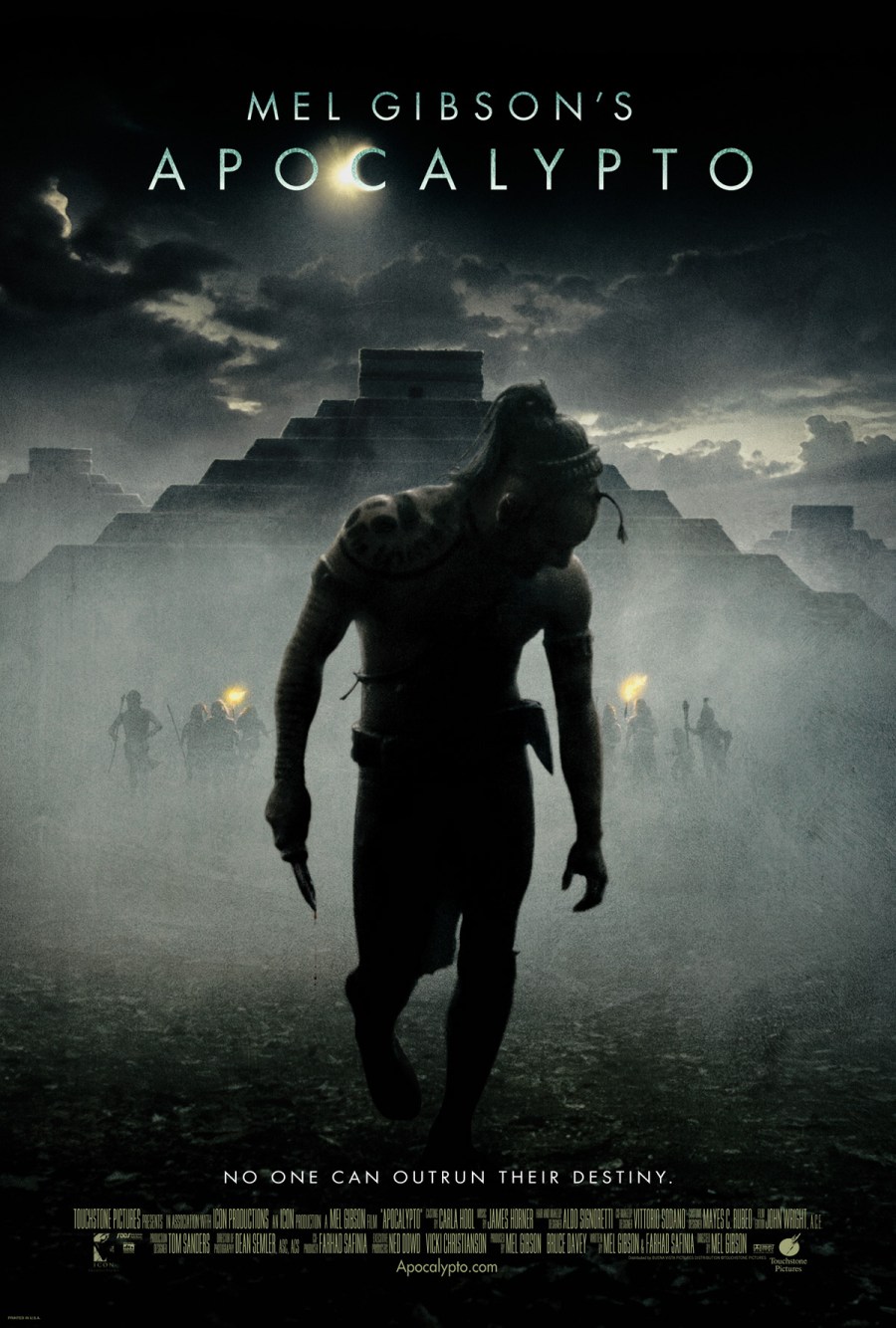
As usual, heavy spoilers (the whole story) throughout the text below.
Perhaps, it’s worth tackling the elephant in the room straight away. Mel Gibson isn’t the world’s most popular person. He is 100% to blame for his infamy – Gibson accrued a bunch of criminal charges, mostly through drunk driving and misdemeanour under the influence of alcohol. He also said a bunch of hateful stuff that is not worth repeating here. If you are familiar with some of the crap that he said, it is well understandable that you may feel somewhat reluctant to separate the art from the artist.
I wish to discuss his 2006 achievement as a filmmaker here, and I have to admit, Gibson has done something remarkable. How many movies can you name off the top of your head that are centred around the 16th-century Mayan civilization in decline, with its characters fluently conversing in the Indigenous Yucatec Mayan language (watch with subtitles)? It’s okay; I’ll wait.
Pardon me for being so glib. I just cannot reconcile the fact that a known bigot could have crafted a time period so lovingly and with such detail that you can’t help but sit enrapt with what’s going on onscreen. Sure, scholars have criticized Gibson for his inaccurate portrayal of the ancient Mayans as less advanced as they really were (Mayans were great urban planners, agronomists and scientists), but cruder historical liberties were taken by more respected filmmakers (looking at you, Ridley Scott). The credit shouldn’t just go to Gibson alone, but rather to a whole crew of historians, screenwriters (kudos, Farhad Safinia), as well as the actors who actually had to read the lines in a language that was most likely unfamiliar to them prior to filming.
The viewer is greeted with an ominous quote right before the beginning of the movie – ”A great civilization is not conquered from without until it has destroyed itself from within”. While I am not a professional historian, I would argue that this doesn’t fully apply to the real ancient Mayans, at least not in view of the moral depravity that is suggested by the movie. Gibson’s Mayan world does indeed focus a bit too much on violence, bloodshed and sacrificial murder – this crowd is reminiscent of the Mad Max-esque post-apocalyptic Citadel, and yes, the fact that Gibson was the first Mad Max (1979) did not escape me. Indeed, the fate of the Gibson’s Mayans was meant to be.
Feel free to pop open a history book and glean a bunch of well-researched historical reasons as to why the Mayan civilization collapsed – environmental issues bringing about drought and famine, overpopulation, war, disease, all the Four Horsemen. Rather than build up to it, the movie establishes a sense of dark foreboding right off the start – you feel as if something is wrong in the air the characters breathe, the way leaves rustle in the Amazonian wind, the way fire flickers as local shaman shares his timeless wisdom. You may believe that the end of the world is nigh, and not due to some mundane reason such as agricultural mismanagement, but rather as divine retribution delivered from above. In fact, the movie’s genetic make-up is closer to that of psychological horror than some historical action drama you may be led to believe.
In a sense, the theme of this movie is the antithesis of the previous movie that I wrote about, Half Nelson (2006). I wrote that Half Nelson dealt with the theme of hope among despair. The theme of Apocalypto is diametrically opposite – it is a movie about nihilistic determinism, about evil omens and about the end of times, mostly through your own fault. You can go to town listing all the historical inaccuracies or harp about the portrayal of the Mayans as not more than noble savages, but I would assert that the movie is more allegorical and less literal than meets the eye. The question we should be asking is – is our collective moral degradation about to deliver us our own end of times? We may view our own modern civilization through a lens of ”man as god”, just like the Mayans do, however, our endless greed and plundering of the Earth’s natural resources and a blatant disregard for human rights may very well signal our own environmental apocalypse. Who are we to say that we are better than they were?
The main character, Jaguar Paw (Rudy Youngblood), his father, Flint Sky (Morris Birdyellowhead), and his fellow tribesmen are first seen hunting a tapir in the Mesoamerican jungle. After playing a tasteful (ha ha) prank on his fellow tribesman, Blunted (Jonathan Brewer), afflicted with some unknown fertility issue, by making him eat some raw tapir testicles to supposedly cure his impotence, our tribesmen encounter a band of refugees escaping from violence and captivity. The refugees are sick, but not just in the literal sense – they are being eaten alive by fear. ”Deep, rotting fear”, Flint Sky warns, ”don’t let yourself be infected by it”.
There’s much to fear as the tribesmen are visited with some violence from the city slickers – the Holcanes (the city is not that far away, surprisingly), there to collect people as material for the ritual sacrifice done to appease the gods above. The raiders are ruthless in their treatment of the village, exercising little care about the contingent of the village and disposing of men, women and children with vicious abandon. Jaguar’s Paw’s father, Flint Sky, is killed then and there by the Holcane thug, Middle Eye, played incredibly well by the incomparable Gerardo Taracena (you may know him as a lovable narcotrafficante Pablo Acosta from the Narcos series). Jaguar Paw manages to hide his pregnant wife and young son in a well to help them escape the same fate, but not everyone else is quite so lucky. The survivors are herded through a treacherous passage into the city, and the forlorn looks of the children left behind inject these scenes not just with pure shock, but with poignance and despair.
As the Holcane raiders and their captured slaves make their way to the city, they come across a smallpox-ridden young girl next to the body of an older woman. At least I think, it was smallpox-like scarring of the face due to the rotting pustules. Could be that, or leprosy, or herpes, or the bubonic plague, or some other horrific disease brought into the New World by the Spanish conquistadores. The raiders are aware of the diseases and dismissively push the girl away, but they may have awoken some dark spirits in the process. In probably the best scene of the entire film, the girl delivers in a raspy voice a bone-chilling prophecy:
”You fear me? So you should. All you who are vile. Would you like to know how you will die? The sacred time is near. Beware the blackness of day. Beware the man who brings the jaguar. Behold him reborn from mud and earth. For the one he takes you to will cancel the sky, and scratch out the earth. Scratch you out. And end your world. He’s with us now. Day will be like night. And the man jaguar will lead you to your end.”
I may be an easily impressionable individual, but in my opinion, the scene was exceedingly well done. Let’s just say, this is not something I hear from 10-year-old girls on a regular basis, but then again, I don’t sacrifice people on the altars either. Yeah, there is a clear supernatural undertone to this entire scene, which suggests that perhaps this is not going a 100% faithful recreation of the time a la HBO’s Rome (which I haven’t watched, but may watch and feature on this blog one day). I was more impressed with the transition from what was looking like a scene where the raiders display their cruelty yet again to the jarring arrival of some otherworldly force, possessing the girl to deliver a less-than-optimistic message about what is going to transpire in the immediate future. Spoiler alert, it does happen as it foretells.
When the slavers and the slaves enter the city, it is as if the apocalypse had already begun. The scenery of the city mixes what was perhaps an accurate description of the Mesoamerican city of the time with the shocking imagery of death and suffering of some post-nuclear world you may see in Fallout (a series of videogames). Accurate or not, it is a visual spectacle, rife with imagery of the people consumed by killing and dying. You may very well disagree with me if you have already watched the movie (and you should, disagreeing is good), but the dread does not let up in the broad daylight.
Sure, the Mayans were somewhat notorious for human sacrifices in order to appease the gods, so you may very well put two and two together to figure out why the local city needs so many slaves. Let me help you out with a clue here – they aren’t looking for partners for a friendly game of backgammon. Naturally, the sacrifice scenes are done with some signature brutality you are already getting used to while watching – else you would be disappointed. JP is saved from having his heart cut out from the thoracic cavity by divine intervention, or so the Mayans are led to believe when the solar eclipse occurs unexpectedly (or very much expectedly) mid-execution to the rapture of the bloodthirsty crowd. Again, this goes against my natural sensibilities, but if I were sacrificing people left, right and centre, I would not construe the sudden blackening of the sky as a sign that everything is about to be okey-dokey from now on, but to each their own, I guess. Again, I doubt that Gibson thinks that this is exactly the way the Mayans behaved. This is not a caricature of them, it is a caricature of us (or, if you are reading this as a Parisian pre-French revolution, caricature de toi).
Jaguar Paw manages to escape, earning the ire of Zero Wolf, the leader of Holcanes since our boy JP trades the deaths of his fellow tribesmen for the death of Zero Wolf’s son, who ZW was sure was not going to die (how would he, the set up to kill the slaves was going so well). One of the best chase scenes in movie history (in my opinion) ensues – no gunshots, no explosions, just pure tension about to erupt into violence as the Zero Wolf and his boys chase down Jaguar Paw making his way through the jungle. Alas, the prophecy. Zero Wolf and his coterie are very much vile people, and according to the smallpox-ridden girl, they are about to get ”scratched out”.
Jaguar Paw, in his own territory and domain, the jungle, manages to strategically outperform and outgun his pursuers through sheer ingenuity and experience. The last third of the movie reminded me of Home Alone, but with more naked butts and cracked skulls, venom poisons and jaguar fangs. Particularly cool was the scene where JP makes use of his immediate environment to catch a frog that probably biosynthesizes copious amounts of epibatidine or some other highly toxic alkaloid to fashion some blow darts which he would later use to shut down the pursuers’ acetylcholine receptors and their entire respiratory apparatus. Thanks, froggy.

As JP exacts his own style of vengeance in the jungle, he is almost cornered by the remaining two pursuers on the shore. JP is saved by divine intervention for the second time, since the Spaniards had just made their way to the New World, like clockwork. Suddenly, the New World has bigger problems than petty revenge (Zero Wolf is dead by then, Home Alone’d, or, actually, Rambo’d by Jaguar Paw’s clever tapir-hunting trap). After all, the sacred time is near. JP’s wife (saved from doom by the neck) wonders who are the people on the ships. Nothing good, amiga, nothing good.
A lot of people seem to be offended by the arrival of Spaniards at the end of the movie. They think that this is Gibson’s unsubtle way of condoning the idea that bloodthirsty savages need to be civilized by the white man, and his offensive remarks in the past do very little to disabuse you of thinking this way, however, I do not think this is what Gibson is trying to convey at all. After all, historically, the European settlers proved a worthy match in carnage and brutality to the real or perceived Native Americans, not to mention the pestilence they had brought that led to the 80 to 95 percent reduction in the indigenous population of the Americas (source – Wikipedia).
No, no. The moral trespasses, blind belief in the superiority of their civilization, and the pursuit of the expedient over making meaningful systemic change displayed by the Gibson’s Mayans throughout the movie should probably serve as a cautionary tale. I don’t think Gibson intended for you to feel much schadenfreude over the collapse of the Mayans. I think he intended to hold up the mirror. Are we really all that civilized? The movie came out in 2006, on the heels of the Iraq War debacle, where the world’s mightiest and the most ”civilized” government decided to wage a civilizing war on a country vastly inferior in military power to sate the insatiable free market (and no, I am not a communist). The point of no return when it comes to reversing climate change and cascading environmental damage had passed in the 1970s-1980s, and we are still cutting out beating hearts, business as usual (and no, I am not an American).
Readers of this blog will have to get used to my pontificating about higher ideals at the end of every blog post, it seems, so this post is not an exception. I just refuse to believe in the cynicism that the movie was made for the sole purpose of mocking and debasing our forefathers. On the contrary, much respect is paid to the rural Mayans, shown clearly as savvy and honourable people, living in sync with their immediate environment and with each other (and the occasional prank where your friends trick you into rubbing some irritant on your crotch in order to help you with your coital needs). Historians were clearly consulted over the course of filming this as the accoutrements of the Mayan life, especially those pertaining to human sacrifice, empower the storytelling to craft a unique visual story. If you’re doing a Ph.D. on the history of the Indigenous people of the Americas, this is an unlikely source to cite in your thesis, but this would do wonders with immersion (historians and archeologists are welcome to disagree).
If you are not in this heady stuff and just want to enjoy a movie full of suspense and a great visual spectacle (no offence intended), the movie clearly delivers, no questions asked. As I previously said, the setting of the movie is unique, and the movie is sprinting and leaping its way toward the end, letting up for just a bit to escalate the stakes even further. Give this movie 30 minutes to convince you to watch itself, and you’re off to the races. Quoting South Park here ”Say what you want about Mel Gibson, but the son of a bitch knows story structure”.
 Grist for the Mill